
AI Automation Agency: What They Do & How to Choose One
Discover what an AI automation agency actually does, which services matter for Australian SMBs, and a practical framework for choosing the right partner.
Quick summary
An AI automation agency designs, builds, and manages AI-powered systems that take repetitive work off your plate: things like answering the same enquiries all day, routing new leads, or filling a CRM by hand. For Australian small and medium businesses, the right agency connects your existing tools and deploys chatbots and workflows so the business keeps moving even when your team is not. The decision comes down to fit: the best agency for your business understands your industry, integrates with your stack, and stays accountable after launch.
Key takeaways:
- AI automation agencies cover three core service areas: smart chatbots, lead response systems, and administrative workflow connections.
- “AI automation” is not one product: it is a stack of tools chosen and configured for your specific processes.
- WhatsApp Business automation and website chatbots are currently the highest-demand deployments for Australian SMBs.
- Choosing an agency on price alone is the most common mistake. Integration depth and post-launch support matter more.
- A practical four-question framework (below) cuts through vendor noise and gets you to the right decision faster.
What does an AI automation agency actually do?
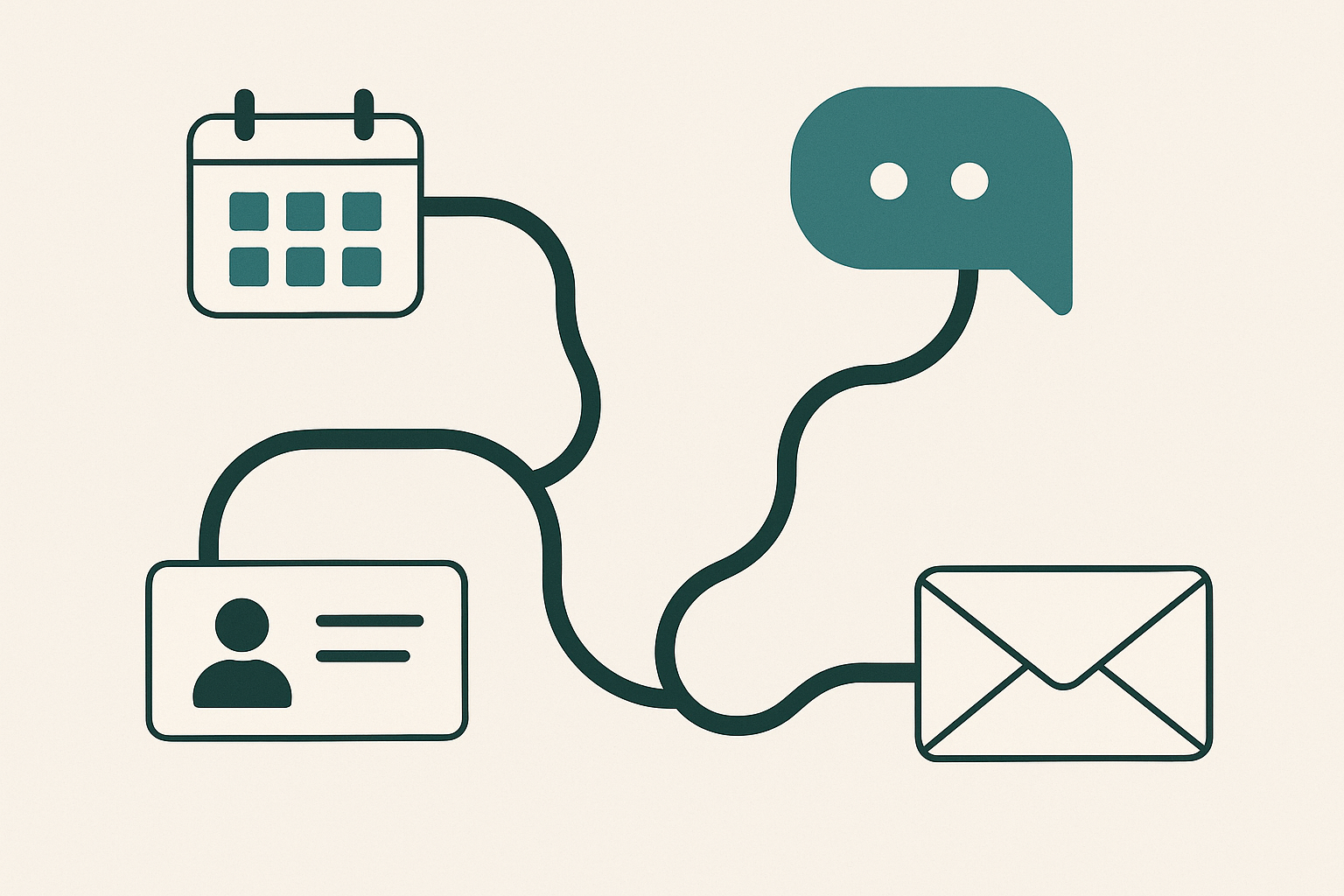
An AI automation agency builds systems that replace manual, repetitive business tasks with software that runs on its own. The three service areas that cover almost every SMB use case are: smart chatbots that handle customer conversations, lead response systems that follow up the moment a prospect enquires, and administrative workflows that connect tools like calendars, CRMs, and email so data moves without anyone typing it twice.
What separates a genuine agency from a software reseller is the configuration work. The tools themselves (chatbot platforms, workflow builders, AI agents) are often available off the shelf. The agency’s value is knowing which combination fits your business, building the logic that makes them behave correctly, and keeping them running as your business changes.
At Attorus, the deployments we run for Australian businesses typically start with one high-friction point (the after-hours enquiry that goes unanswered, the leads that wait 48 hours for a callback) and expand from there once the first system proves itself.
Why Australian SMBs are turning to this category now
The commercial case for AI automation in Australia has shifted from “interesting experiment” to “competitive baseline” in the past 18 months, and the SERP for this topic reflects it: nearly every result targeting Australian buyers comes from offshore agencies (UK and US) with no local context. That gap is the practical problem Australian business owners face when researching this category.
Two local factors make Australian SMB deployments distinct:
Business hours and after-hours volume. Australian consumer behaviour skews toward enquiring outside the 9–5 window (evenings and weekends), which means a business without automated coverage is leaking qualified interest every night. Our AI answering service work for Australian small businesses addresses exactly this pattern.
WhatsApp adoption. WhatsApp Business automation is growing faster in Australia than website chat, driven by the platform’s near-universal smartphone penetration. Businesses that deploy WhatsApp for business automation can meet customers in the channel they already use daily, rather than asking them to find a website widget.
The four services that move the needle (and what they are not)
Not every automation is worth building. These are the four deployments that consistently deliver measurable time savings for the SMBs we work with:
1. Lead response automation
When a prospect fills out a form, books a free consult, or sends an enquiry, an automated system fires an immediate, personalised reply (via SMS, email, or WhatsApp) and logs the contact into your CRM without anyone touching a keyboard. Speed-to-contact is the single biggest variable in lead conversion, and this is where automation earns its keep fastest.
2. AI chatbots for customer enquiries
Smart chatbots trained on your business information handle repetitive questions (pricing, availability, process, location) across your website and social channels. Unlike a generic FAQ page, a well-configured chatbot holds a conversation, qualifies the prospect, and either books an appointment or routes the query to the right person. See how this works in practice with Attorus’s AI receptionist for Australian small business.
3. WhatsApp Business automation
WhatsApp for business automation moves routine conversations (appointment confirmations, payment reminders, post-service follow-up) into a channel with open rates that email cannot match. The configuration work involves connecting WhatsApp’s Business API to your booking or CRM system and building the message logic. This is not the same as a WhatsApp broadcast list; it is two-way, trigger-based conversation automation.
4. Administrative workflow connections
CRM data entry, invoice creation from booking data, scheduling logic, internal notifications: these are the invisible time drains that add up across a week. Connecting your existing tools (Google Workspace, a practice management system, an e-commerce platform) with automation removes the manual handoffs between them.
What these are not: a one-time setup that runs forever without attention. Every automated system needs monitoring, prompt updates, and periodic review as your business processes change. An agency that does not offer ongoing support is selling you a product, not a service.
How to evaluate chatbot companies and AI agencies: a four-question framework
The Australian market for AI automation agencies is noisy. Offshore providers dominate search results; local generalist digital agencies have added “AI” to their service lists without deep capability; and a wave of new entrants has emerged selling courses on how to start an AI automation agency, which is not the same as an agency that runs them at scale.
These four questions cut through the noise:
| Question | What a strong answer looks like | Red flag |
|---|---|---|
| What tools do you connect to? | Names your existing stack specifically; explains integration method | ”We use the best tools for your needs” (vague) |
| Who manages it after go-live? | Dedicated support contact, SLA for response time, clear change process | ”It runs itself” or no support plan |
| What is your experience in my industry? | Specific workflow knowledge (e.g., clinic booking logic, trade quoting) | Generic case studies from unrelated verticals |
| How do you measure success? | Agreed KPIs before build (response time, conversion rate, hours saved) | “You’ll see the results” without a measurement plan |
The best chatbot companies in this space will also tell you upfront what they will not automate. A business with complex, judgment-heavy customer interactions needs a human in the loop, and an agency that claims otherwise is overselling.
WhatsApp Business automation: the underused channel for Australian SMBs
WhatsApp Business automation deserves its own section because it is the fastest-growing deployment we see in Australia and the least understood by business owners researching this category.
WhatsApp for business automation, using the official WhatsApp Business API, lets you build automated conversation flows that trigger based on customer actions: a new booking, a payment, a missed appointment. The conversation happens inside WhatsApp, the app your customer already checks dozens of times a day.
For service businesses (allied health, trades, professional services), this means appointment reminders and confirmations no longer require a staff member to make calls. For retail and e-commerce, it means order updates and customer service queries are handled in the same channel the customer used to ask about the product.
The setup requires API access (not the free WhatsApp Business app) and integration with your booking or CRM system, which is exactly where an agency adds value over a DIY approach.
If you want to see whether WhatsApp automation fits your current workflow, book a no-obligation scoping call and we will map it against your existing tools before recommending anything.
What separates top AI chatbot companies from the rest
The difference between top AI chatbot companies and average ones shows up not in the demo but in month three of deployment. By then, the initial configuration is running and the real variables emerge: how well the chatbot handles edge cases, whether it escalates correctly when it should not answer, and how fast the agency responds when something needs adjusting.
Three markers of a mature AI automation agency:
Conversation design depth. A chatbot built on good conversation design handles unexpected inputs without falling over. This means someone on the agency team has mapped the range of things your customers actually say, not just the happy path.
Escalation logic. Every automated system needs a clear rule for when the AI hands off to a human. Agencies that skip this create frustrated customers and staff who have to fix conversations that went off-script.
Prompt and model maintenance. AI models update. Platform APIs change. A responsible agency has a process for reviewing and updating the systems they built so performance does not degrade quietly over time.
How to get started with an AI automation agency in Australia
The practical starting point is not choosing a platform or comparing chatbot software companies on a feature list. It is a workflow audit: mapping the tasks your team does repeatedly, estimating the time cost, and identifying which ones follow a consistent enough pattern to automate reliably.
From there, a good agency proposes a phased approach: typically one high-impact automation first, measured against agreed KPIs, before expanding into adjacent workflows. This approach reduces risk and gives you real data before you commit to a broader programme.
Attorus works with Australian SMBs across service industries to design and deploy these systems. If you want to understand what automation is realistic for your business, start with a scoping conversation: no jargon, no commitment, just a clear picture of where automation helps and where it does not.